Garage Frequency: The Micro-Radio DJs Making a Few Blocks Feel Like a Whole World
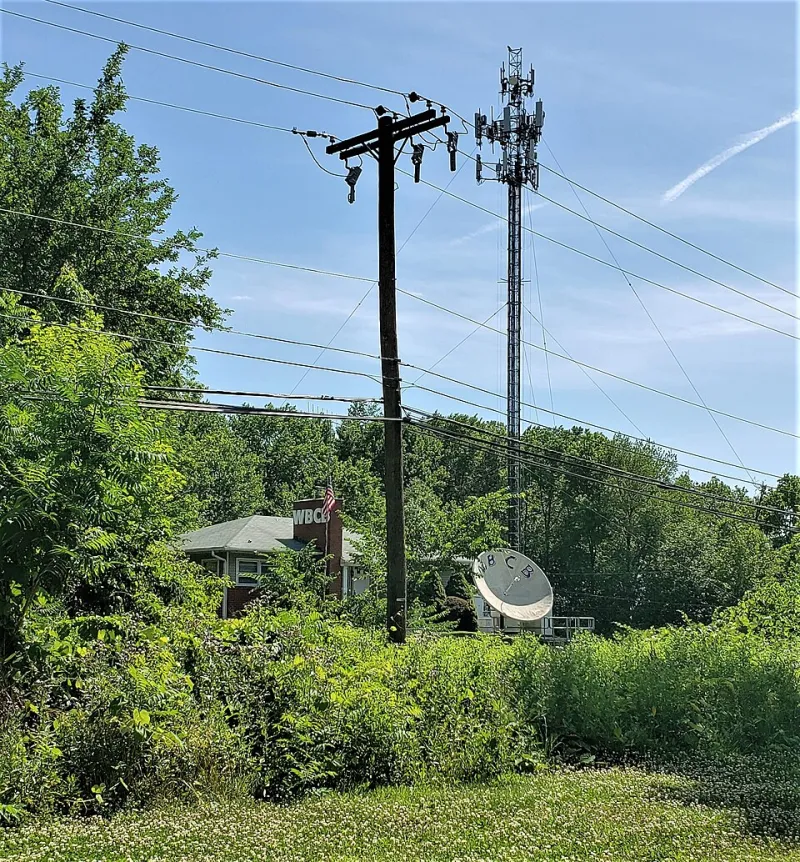
Photo: Lilypad.ua, CC BY-SA 4.0, via Wikimedia Commons
The signal from the cul-de-sac
On a damp Tuesday in Asheville, North Carolina, Nadia Reyes climbs over a box of Christmas decorations, flips a switch on a transmitter the size of a hardback book, and leans into a microphone. 'Good evening, Beaucatcher Mountain,' she says. 'This is Porch Light Radio, 1620 on your AM dial, and I have a lost cat report, a birthday shout-out, and forty-five minutes of obscure garage rock.' Her audience might be twelve people. On a good night, twenty. The signal reaches roughly six blocks before it dissolves into static and somebody else's ballgame.
This is micro-radio in 2026: tiny, unlicensed (or very low-power licensed) stations run by hobbyists, retirees, and music nerds from garages, basements, and backyard antennas. They are not trying to compete with Spotify, iHeart, or the podcast industrial complex. They are trying to make a few blocks feel like a whole world.
Three operators, three frequencies
Reyes is one of a loose network of micro-broadcasters I spoke with this fall. Her station, Porch Light, runs on a part 15 AM transmitter and a playlist that swings from Lucinda Williams to local callers reading their grocery lists. She started it during the pandemic as a way to talk to her neighbors without, as she puts it, 'another damn group chat.' Now it is a fixture. People leave notes in her mailbox. The guy two streets over requests Conway Twitty every Friday. A middle schooler does a five-minute weather report called 'Cloud Report.'
In Tucson, Arizona, Marcus Bell runs Barrio Static out of a converted tool shed. His signal is FM, barely, and his programming is aggressively local: high school football scores, water main breaks, a segment called 'What Was That Noise?' where listeners call in to identify sounds. 'I am not a journalist,' Bell says. 'I am a guy with an antenna and a loose relationship with boundaries.' He laughs. 'But people want to know what is happening on their street. Not the street two miles away. Their street.'
Then there is Doreen Kwon in Cleveland, Ohio, who broadcasts from the laundry room of her duplex. Her station is called The Spin Cycle, and it is mostly music—polka, gospel, forgotten 1970s soul—plus a weekly show where she interviews whoever wanders in. 'I do not have a demographic,' Kwon says. 'I have neighbors.' She has been doing it for three years. Her transmitter is small enough to fit in a shoebox. Her reach is about four blocks. Her impact, if the handwritten thank-you notes taped to her door are any indication, is larger.
Why now?
Micro-radio is not new. Part 15 rules have allowed low-power, unlicensed broadcasting for decades, and the FCC has periodically cracked down on stations that color outside the lines. But the current wave feels different—less pirate radio rebellion, more neighborhood infrastructure. The operators I spoke with described the same itch: algorithmic entertainment has become frictionless and weirdly lonely. A playlist tailored to your taste is efficient. A neighbor reading the city council agenda in a monotone is not. That is the point.
'There is a kind of intimacy in a small signal,' says Dr. Elaine Croft, a media studies professor at a midwestern university who studies hyperlocal media. 'When you know the broadcast only reaches a few blocks, you listen differently. You feel addressed. You feel responsible.' Croft compares micro-radio to a bulletin board or a church newsletter—formats that seem obsolete until you need them. 'These stations are not trying to scale,' she says. 'They are trying to belong.'
That belonging is often gloriously weird. Reyes once devoted an entire show to the history of a single pothole. Bell has a recurring segment where listeners describe their dreams and he tries to guess what they ate for dinner. Kwon reads the obituaries from the local paper, slowly, with commentary. 'People love it,' she says. 'I think they like hearing a human voice take their neighbors seriously.'
The intimacy of a small signal
The technical setup is usually modest: a transmitter, an antenna, a mixer, maybe a laptop. The content is whatever the operator can conjure. There are no focus groups, no brand consultants, no audience analytics beyond what people tell you at the grocery store. That constraint is also a freedom. You can play a ten-minute field recording of rain on a tin roof. You can interview a guy about his prize-winning tomatoes. You can be boring. Boring is allowed.
The listeners, in turn, become collaborators. They call in. They request songs. They drop off CDs with handwritten track lists. They complain when the signal is weak. They show up at the garage door with cookies. In a media landscape built on scale, micro-radio offers something else: the pleasure of being one of twelve people in a room, even if that room is separated by walls, yards, and a fragile slice of spectrum.
Reyes says she has no plans to grow. 'If I got a thousand listeners, I would have to think about what they want,' she says. 'Right now, I think about what my neighborhood wants. That is a shorter list, and it is much more interesting.' She pauses. The transmitter hums. Somewhere a few blocks away, a radio crackles to life.


